
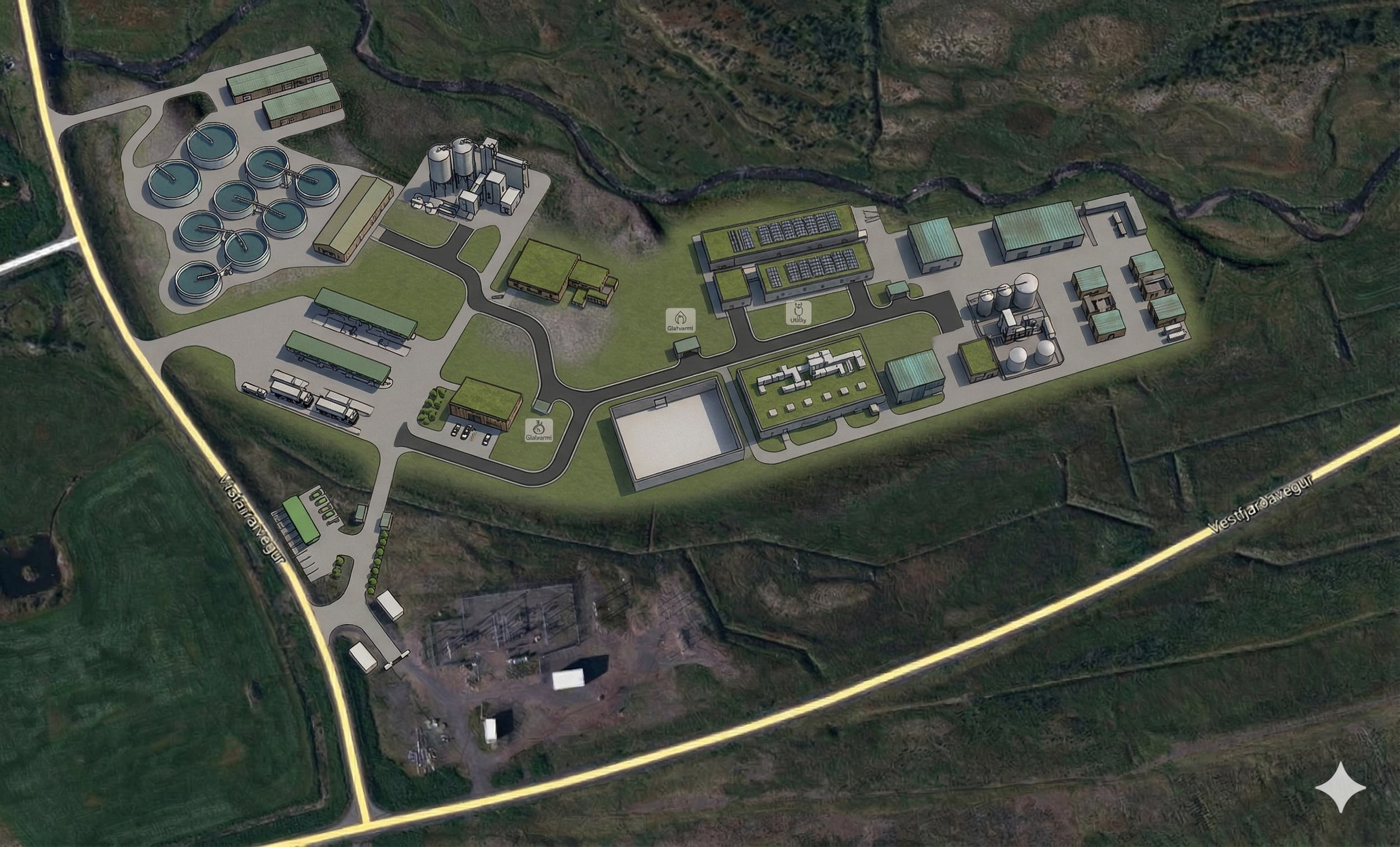
Westfjords Eco-Business Park
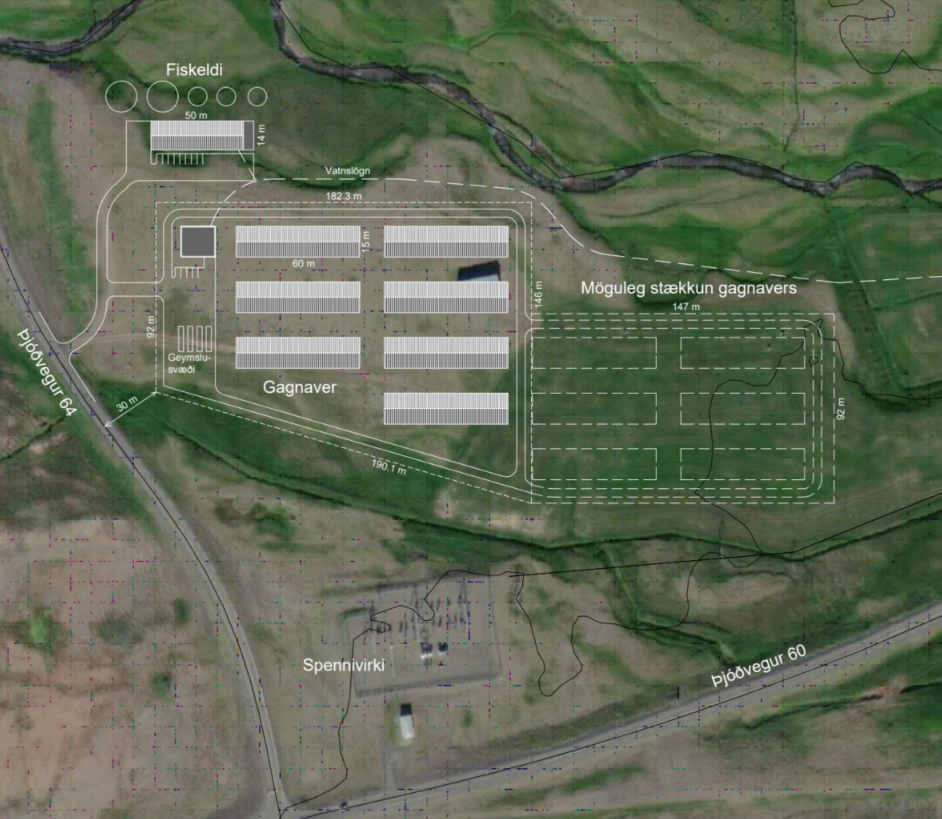
BlueFjords offers a unique opportunity for industrial development on a 13-hectare site at Ytri-Veðrará in Önundarfjörður, Westfjords. Specifically engineered to host diverse high-tech operations and clean-tech manufacturing, the site is a cornerstone for sustainable innovation in Iceland.
Unmatched Flexibility and Infrastructure The site is designed to accommodate a wide range of industrial activities, from high-performance computing to advanced manufacturing. The plot layout is highly adaptable, offering the flexibility to customize facilities and expand as industrial demands grow. Strategically zoned for industrial use under the Local Development Plan, the site ensures a streamlined and predictable planning process, allowing for rapid deployment of new projects.
Circular Economy in Action At the heart of BlueFjords is a commitment to a Circular Industrial Ecosystem. By fostering collaboration between diverse sectors, we create high-value synergies:
Resource Synergy: High-heat operations (such as data centers or tech manufacturing) can directly provide excess thermal energy to land-based aquaculture or high-tech greenhouses.
Clean-Tech Integration: The site is ideally positioned for e-fuel production, Direct Air Capture (DAC), and other circular processes where outputs from one process become valuable inputs for another.
Strategic Location and Power Security With a power capacity of 10–30 MW and immediate proximity to a major regional substation, BlueFjords provides the high level of energy security and redundancy required by power-intensive industries. Furthermore, a triple-redundant fiber optic ring ensures world-class global connectivity and low-latency data transmission.
BlueFjords represents more than just an industrial plot; it is a forward-thinking ecosystem for companies seeking to lead the transition toward a renewable-energy-driven industrial future.
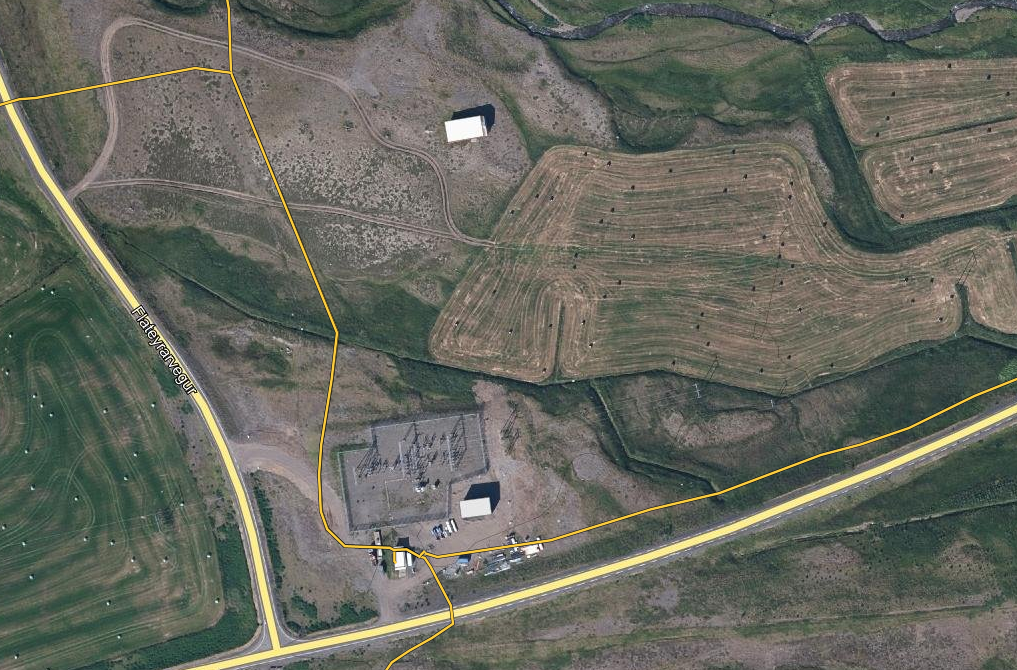
On-Site Energy Infrastructure
The Önundarfjörður site offers a premier industrial advantage due to its immediate proximity to Landsnet’s newly commissioned Breiðadalur substation. This state-of-the-art GIS (Gas-Insulated Switchgear) facility ensures high operational reliability by protecting critical infrastructure from the harsh Arctic elements and salt spray, providing a level of power stability ideal for sensitive high-tech operations.
Key Energy Advantages:
Immediate Scalability: On "Day One," the site is positioned to support industrial loads of 10–30 MW at the 66 kV voltage level. The substation is engineered with available bays, allowing for straightforward, high-capacity connections with minimal lead time.
Future-Proof Infrastructure: Designed with long-term growth in mind, the Breiðadalur facility is 132 kV ready. This allows for a seamless transition to higher voltage levels as power demand scales, potentially unlocking over 100 MW of capacity to meet the needs of large-scale green industries.
Superior Reliability (N-1 Redundancy): The site benefits from robust grid integration designed to meet N-1 security standards, ensuring that operations remain stable even during maintenance or unforeseen line disturbances.
Operational Resilience: For industries requiring zero-downtime, the site’s layout is optimized for the integration of localized backup power systems or BESS (Battery Energy Storage Systems), further enhancing the inherent security of the grid connection.
By leveraging the most modern substation in the Westfjords, the Eco-Business Park provides a unique plug-and-play opportunity for data centers, green hydrogen producers, and high-tech manufacturing, combining massive power availability with a commitment to 100% renewable energy.
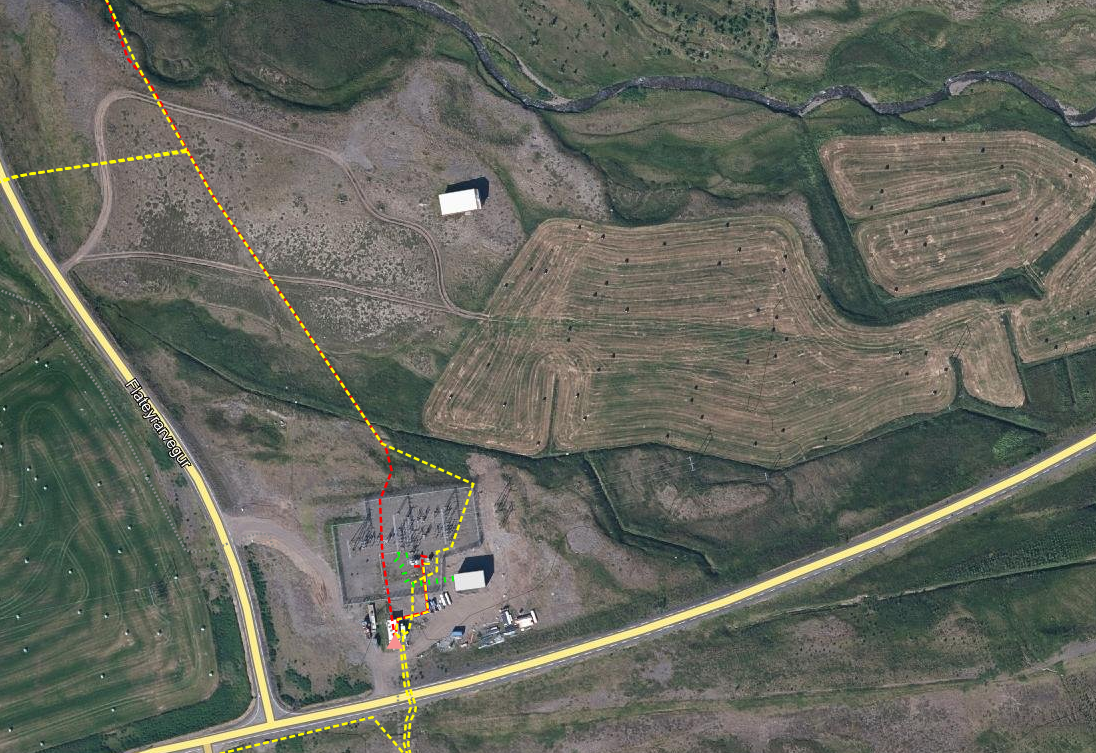
On-Site Fiber Optic Infrastructure
The proposed site is located in an optimal position with respect to fiber infrastructure in the region, as the Westfjords fiber ring passes directly through the property. Three operators have fiber present at the site: Míla, Orkufjarskipti, and Snerpa. Snerpa, an ISP and fiber operator based in Ísafjörður, provides local services in the area.
Míla, formerly the incumbent operator in Iceland, has already deployed active DWDM equipment in Ísafjörður and Tálknafjörður. Míla’s connections enable delivery of multiple 100 Gbps links, and 400 Gbps capability is under development. Sharing the same cable is Ljósleiðarinn hf., which also operates DWDM equipment of comparable capacity, with service points in Ísafjörður and Bíldudalur.
Additional delivery points can be established as needed. Other fibers available on-site include diverse routes to Ísafjörður operated by Orkufjarskipti and the Icelandic Road and Coastal Administration, though upgrades may be required to increase the number of accessible fibers. There is also a diverse connection to Mjólkárvirkjun, operated by Snerpa. Mjólkárvirkjun is expected to connect to Bíldudalur via an alternative route in 2026. Network diversity could be maximized by sourcing bandwidth from Míla in Ísafjörður and from Ljósleiðarinn in Bíldudalur (or possibly from closer locations such as Þingeyri or Holt in Önundarfjörður). Both DWDM operators also provide international bandwidth.
Cooling Options
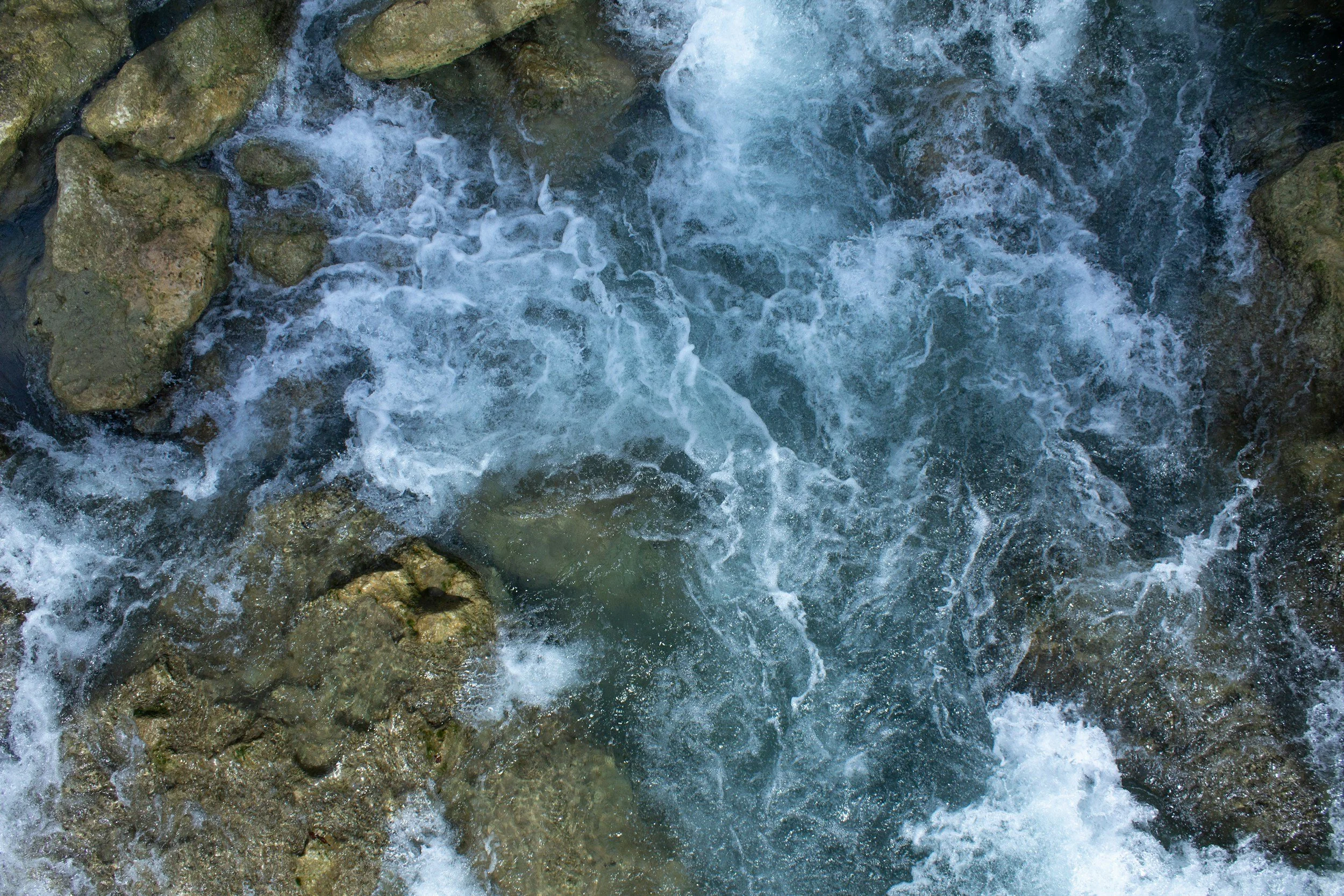
Önundarfjörður offers favourable conditions for industrial cooling due to the availability of cold freshwater resources in the area. The fjord’s naturally cool climate and the presence of local rivers and streams create a stable and reliable source of low-temperature water that can be used for various industrial processes, including green industry, data-driven operations, and energy-intensive manufacturing. This reduces the need for mechanically generated cooling, lowering operational costs and improving overall energy efficiency.
A key advantage of the location is the potential to cascade the cooling resource. After the water has been used for industrial cooling—where it remains clean but becomes slightly warmed—it can be redirected to support land-based aquaculture operations. Many fish species, particularly in juvenile stages, benefit from stable, controlled water temperatures that are slightly warmer than natural stream conditions. Reusing the cooling water in this way enhances resource efficiency, reduces energy demand for temperature regulation in fish farms, and supports sustainable, circular-economy development within the fjord.
This combination of natural cooling capacity, renewable water flow, and opportunities for secondary use makes Önundarfjörður an attractive location for environmentally responsible industrial and aquaculture projects.