
Westfjords Infrastructure
Önundarfjörður offers a range of characteristics that make it an ideal location for the development of green industry in Iceland. First and foremost, the fjord is situated in a naturally sheltered environment with excellent access to clean, renewable energy. The Westfjords region benefits from abundant hydropower resources, and there is significant potential for future development in wind and tidal energy. This ensures that industrial activity in Önundarfjörður can be carbon-neutral or even carbon-negative.
The area also has relatively low population density and ample land available for sustainable industrial development without compromising local quality of life or the region’s natural beauty. Nearby ports in communities such as Flateyri and Ísafjörður provide opportunities for environmentally friendly transportation of raw materials and finished goods, both domestically and for export.
Furthermore, the communities of the Westfjords are known for their strong environmental awareness and commitment to sustainable development. Establishing green industry in Önundarfjörður could create new jobs, stimulate innovation, and diversify the local economy — while reinforcing the region’s image as a leader in sustainability and clean production.
The combination of clean energy, good port and transport infrastructure, community support, and pristine nature makes Önundarfjörður a unique and forward-looking location for the growth of green industry in Iceland.
Infrastructure in the Northern Westfjords
The northern Westfjords have a range of infrastructure that supports business, settlement, and future opportunities in the region. Transportation has improved significantly in recent years, especially with the development of the Westfjords Road and new tunnels such as the Dýrafjörður Tunnel, which connects Önundarfjörður and Dynjandisvogur. These projects have shortened travel distances and enhanced access to Ísafjörður, the area’s main service and economic center. Ísafjörður Airport provides regular connections to the capital area, and ports in Ísafjörður, Flateyri, and Súðavík offer solid facilities for fishing, cargo transport, and potential innovation linked to green industry.
The Westfjords’ electricity network is connected to the national grid through transmission lines from Mjólká and nearby hydropower plants, which produce clean, renewable energy. Although power shortages have occasionally been a challenge, work is underway to strengthen the grid and ensure greater reliability through new transmission lines and potential renewable sources such as wind energy.
Telecommunications and digital infrastructure are steadily improving, with fiber-optic connections reaching most settlements, making the region competitive in terms of digital capacity. Water supply, wastewater, and waste management systems are well established, and municipalities place strong emphasis on sustainability in operations and planning.
Overall, the northern Westfjords have robust core infrastructure that provides a strong foundation for continued community development, economic growth, and the establishment of new green industry initiatives in the region.

Fibre‑Optic Infrastructure
The Westfjords region, including the remote fjord of Önundarfjörður, is now largely connected to Iceland’s national fibre‑optic (FTTH) network, providing a foundation for reliable digital communication and supporting modern industrial operations. Nationwide, about 77% of households are connected via optical fibre, and government initiatives aim to extend coverage to the remaining rural settlements by around 2026. For the Westfjords, this means that even isolated communities now have fibre‑optic access, although there are occasional limitations in redundancy, service quality, and mobile coverage along remote roads and valleys.
Local service agreements, such as those with ISPs like Snerpa for the University Centre of the Westfjords, demonstrate ongoing upgrades from older fibre networks to modern, high‑capacity systems. While the network is sufficient for many purposes—including remote monitoring, automation, and data transfer—industrial projects should verify site-specific fibre access, speeds, and backup connectivity to ensure continuous operation. Overall, the existing fibre‑optic infrastructure significantly enhances the region’s attractiveness for green industry development, providing essential digital support for sustainable and technologically advanced operations.
Power Development and System Reliability
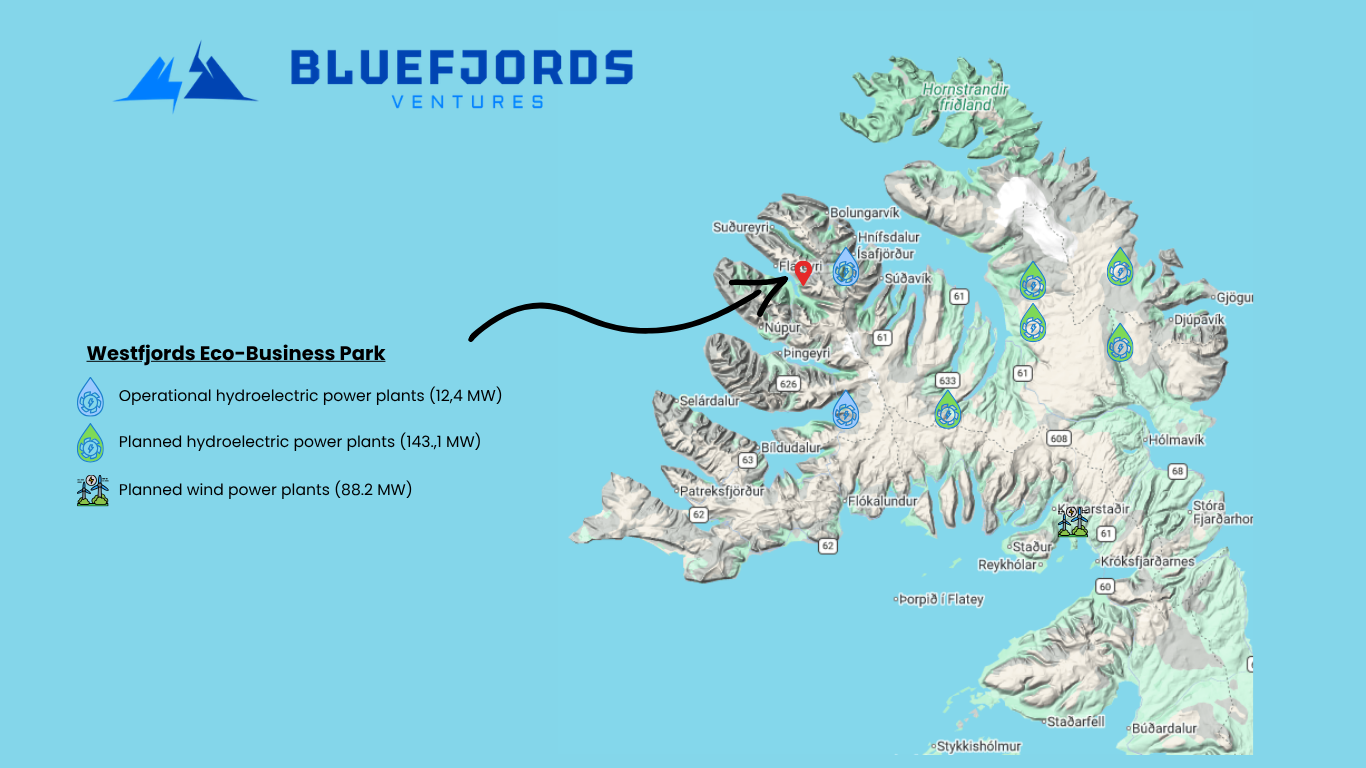
The Westfjords region has significant potential for further renewable energy development. Currently, most electricity in the area comes from hydropower, primarily from the Mjólká stations, supplying clean, renewable energy through the regional transmission network. However, the transmission capacity has historically been limited, occasionally affecting reliability in remote communities.
Several hydropower projects are planned in the region, including the Hvalá Power Plant in Árneshreppur (estimated 55 MW, ~320 GWh/year), the Skúfnavatn Power Plant (~16 MW), and the Hvanneyradalur Power Plant (~13.5 MW). These projects are intended to strengthen local energy independence and improve the availability of clean electricity.
Landsnet, Iceland’s national transmission system operator, has an approved System Plan 2023‑2032, which includes the reinforcement of the national transmission network. Key measures relevant to the Westfjords include strengthening connections from Hvalfjörður northwards with higher-capacity lines (220 kV), upgrading substations, and improving monitoring and control systems to enhance reliability and redundancy. These improvements aim to support the integration of new renewable energy projects and ensure secure energy supply to remote communities.
Interest in wind power is also growing in the northern Westfjords due to favorable conditions and available land. Wind projects could complement hydropower, diversify the energy mix, and support future green industry development.
Backup power systems are already in place in most settlements, currently relying on diesel generators for emergency supply. Over time, there is interest in transitioning to cleaner solutions, such as hydrogen, biofuels, or locally stored renewable energy, in line with Iceland’s sustainability goals.
Together, these measures — planned renewable generation, Landsnet’s grid reinforcement, and modernized backup systems — are strengthening the Westfjords’ energy security and laying the foundation for sustainable growth and the development of green industries in the region.